
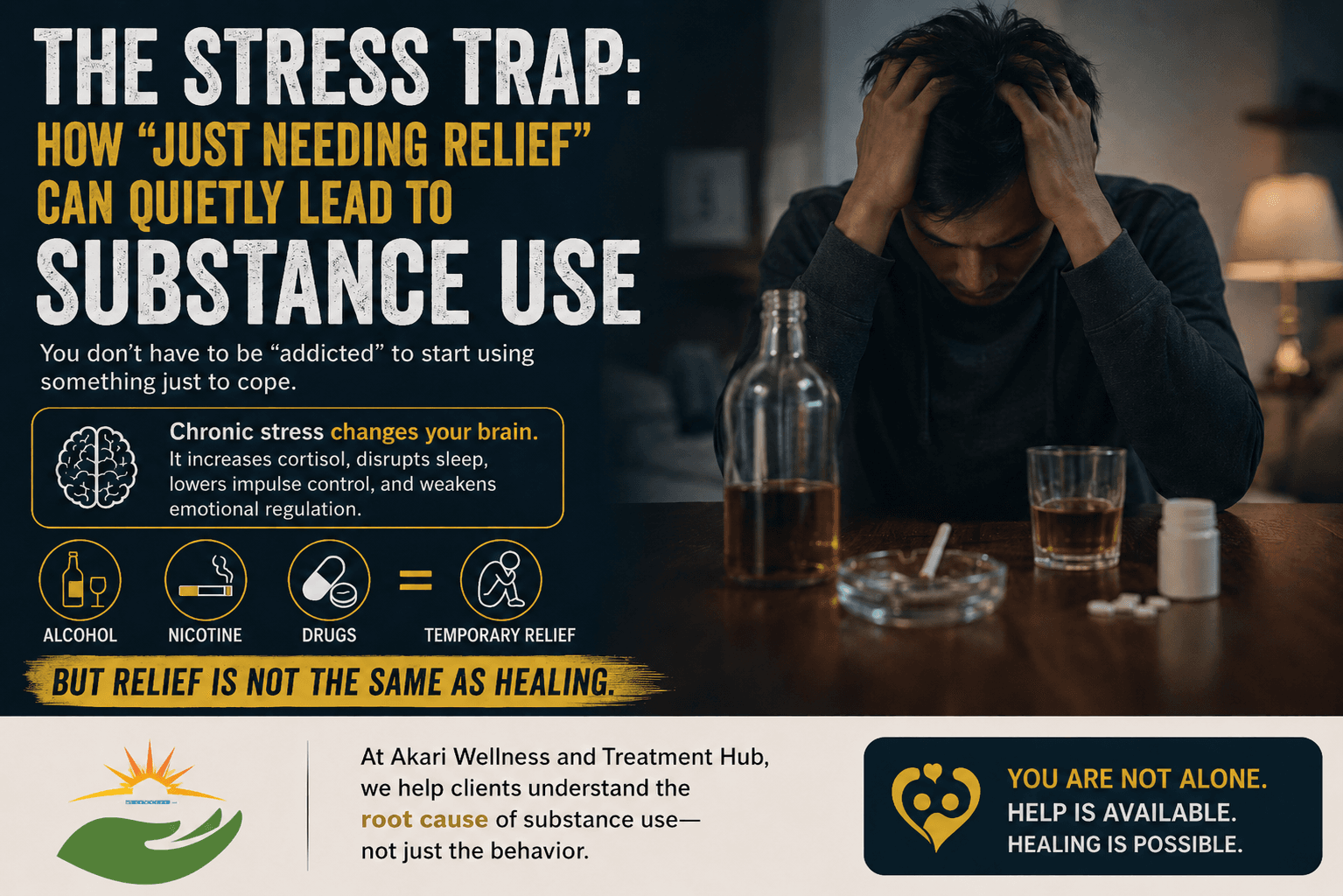
Stress does not always look like a breakdown.
Sometimes, it looks like a person who keeps working, keeps showing up, keeps smiling, and keeps telling everyone they are fine.
But behind closed doors, they may be using alcohol, nicotine, or drugs just to calm down, sleep, escape pressure, or make it through another day.
This is one of the reasons substance use can be so hard for families to recognize early. It does not always begin with reckless behavior. Sometimes, it begins with stress.
A person does not have to think of themselves as “addicted” to start depending on something for relief. What may begin as an occasional way to relax can slowly become a coping pattern, especially when stress is constant and emotional support is limited.
At Akari Wellness and Treatment Hub, we help individuals and families understand what is happening beneath the behavior, not just the substance use itself.
Because relief is not the same as healing.
Can Stress Really Lead to Substance Use?
Yes, it can.
When stress becomes chronic, the body and brain stay in a heightened state for too long. This can affect sleep, mood, decision-making, emotional regulation, and the ability to manage impulses.
The National Institute on Drug Abuse explains that substance use can affect brain circuits involved in reward, stress, and self-control, which helps explain why repeated use can become harder to stop over time.
Stress also changes how a person looks for comfort. When someone feels overwhelmed for weeks, months, or even years, they may start reaching for the quickest form of relief available.
For some, that may be alcohol after work.
For others, it may be nicotine, prescription medication misuse, or illegal drugs.
For some, it may start as “just this once” or “only when things get too heavy.”
The problem is that the brain can begin to connect the substance with relief. Over time, the person may not only want it, they may feel like they need it to function.
Why Stress-Based Substance Use Is Easy to Miss
Many families expect substance use problems to look obvious. They may imagine extreme behavior, visible impairment, or major life consequences.
But stress-related substance use can be much quieter.
A loved one may still go to work.
They may still care for their family.
They may still attend school, manage responsibilities, or appear productive.
This is why families often say things like:
“Maybe they are just tired.”
“They are under a lot of pressure.”
“They only drink to relax.”
“They can still function, so maybe it is not serious.”
“They promised they can stop anytime.”
These thoughts are understandable. Families want to believe their loved one is okay.
But substance use does not have to look extreme to be concerning. If someone is using alcohol, nicotine, or drugs as their main way to cope with stress, it may already be a sign that deeper support is needed.
Start Your Journey to True Wellness Today!
Join our healing community for expert tips, mental health insights, and wellness inspiration. Sign up now for a calmer, healthier you!
The Difference Between Relief and Healing
Relief is immediate.
Healing takes work.
A drink, a smoke, or a substance may temporarily quiet anxiety, numb sadness, reduce tension, or help someone feel disconnected from their problems. But when the effect wears off, the stress is usually still there.
The bills are still there.
The family conflict is still there.
The grief is still there.
The pressure is still there.
The emotional pain is still there.
This can create a cycle:
Stress builds up.
The person uses something to cope.
They feel temporary relief.
The problem remains unresolved.
Stress returns.
They use again.
Over time, the person may become less confident in their ability to cope without the substance.
That is why treatment should not focus only on stopping the behavior. It should also help the person understand the root cause behind it.
Common Signs That Stress May Be Driving Substance Use
Families and decision makers often notice changes before the person is ready to admit something is wrong.
Here are signs to watch for:
They use substances after stressful situations
If drinking or using usually happens after work, arguments, financial pressure, family issues, or emotional distress, stress may be a major trigger.
They say they “need” it to relax
Phrases like “I just need a drink,” “This is the only thing that calms me down,” or “I can’t sleep without it” may point to dependence on the substance as a coping tool.
Their mood changes when they cannot use
They may become irritable, anxious, restless, withdrawn, or emotionally reactive when they do not have access to the substance.
They isolate more often
A person may avoid family, cancel plans, hide in their room, or create distance to avoid questions.
They deny the problem, even when others are concerned
Defensiveness does not always mean they do not care. Sometimes, it means they feel ashamed, afraid, or unable to imagine coping differently.
Their responsibilities start to suffer
This may include missed work, poor performance, financial problems, broken promises, neglected relationships, or a noticeable drop in motivation.
They keep saying they will stop, but the pattern continues
Repeated promises followed by the same behavior may be a sign that willpower alone is not enough.
Why Families Should Not Wait for Things to Get Worse
Many families wait because they do not want to overreact.
They may think, “It is not that bad yet.”
But early support can make a big difference. Substance use disorder can range from mild to severe, and it is considered treatable with the right support and care.
Waiting until the situation becomes severe can make recovery harder for the individual and more painful for the family.
Support does not always mean forcing someone into treatment immediately. It can start with a calm conversation, a professional assessment, or family guidance on what to do next.
The important thing is not to ignore the pattern.
What Families Can Do When Stress Is Behind Substance Use
If you are worried about a loved one, approach the situation with care. Shame, anger, and confrontation can make the person more defensive.
A better starting point is concern, honesty, and support.
You might say:
“I’ve noticed you seem overwhelmed lately, and I’m worried about how you’ve been coping.”
“I’m not here to judge you. I just want to understand what’s been going on.”
“You do not have to handle this alone.”
“Maybe we can talk to someone who can help us figure out the next step.”
SAMHSA notes that family therapy, counseling, and support groups can help families cope and may improve treatment effectiveness by supporting the whole family, not only the individual.
This matters because substance use does not affect one person only. It affects trust, communication, emotional safety, and family stability.
When the family receives guidance, they can respond with more clarity and less panic.
Why Root Cause Matters in Recovery
Substance use is often the visible behavior.
But underneath it, there may be stress, trauma, grief, anxiety, burnout, loneliness, family conflict, low self-worth, or emotional pain.
If these deeper issues are not addressed, the person may stop using for a while but still feel overwhelmed inside.
That is why root cause treatment matters.
At Akari Wellness and Treatment Hub, we help clients look beyond the surface. We support individuals in understanding what they are trying to escape, numb, or manage through substance use.
This may include learning healthier coping skills, rebuilding emotional regulation, improving communication, strengthening routines, and creating a recovery environment that supports long-term healing.
The goal is not only to stop the substance use.
The goal is to help the person build a life where they no longer need substances to survive stress.
Stress Is Not an Excuse, But It Is a Signal
Stress does not remove personal responsibility.
But it can help explain why substance use started and why it continues.
For families, this perspective is important. It allows you to see the person with more compassion while still taking the situation seriously.
Your loved one may not simply be “making bad choices.”
They may be overwhelmed, emotionally exhausted, and stuck in a coping cycle they do not know how to break.
That does not mean the behavior should be ignored. It means the response should include both boundaries and support.
When to Seek Professional Help
It may be time to seek support if:
Your loved one uses substances to cope with stress regularly.
They become defensive or secretive about their use.
Their mood, work, health, or relationships are being affected.
They have tried to stop but keep returning to the pattern.
Your family feels confused, worried, or emotionally drained.
You do not have to wait for a crisis before asking for help.
A professional assessment can help determine what level of care is needed and what kind of support will be most helpful.
A Message for Families and Decision Makers
If you are reading this because you are worried about someone, your concern matters.
You may be seeing something they are not ready to see yet.
Stress-related substance use can be quiet in the beginning, but it can grow into something more serious if left unaddressed.
The earlier a person receives support, the more opportunity there is to understand the root cause, rebuild healthier coping skills, and protect the relationships that matter most.
At Akari Wellness and Treatment Hub, we believe healing begins when people feel safe enough to be honest about what they are carrying.
Substance use may be the behavior you see.
But stress, pain, and emotional exhaustion may be the story underneath.
And that story deserves care.
Take the First Step Toward Support
If stress has quietly become the reason for drinking or using, this may be the right time to seek help.
Whether you are struggling personally or you are concerned about a loved one, Akari Wellness and Treatment Hub is here to guide you with compassion, structure, and professional support.
Reach out to Akari Wellness and Treatment Hub today to learn how we can help you or your loved one begin the path toward healing.